Category Archives: winter

Tracking reinspired

One of my childhood favourites was Mark Trail’s Book of Animal Tracks, a book brought into the household collection from one of my parent’s childhood bookshelves. (As a child I often pondered the surprising appropriateness of the author’s name – a penname? Or the inevitable outdoorsman career choice with a name like that, like lawyers with the surname Law? To my disappointment I discovered recently the solution to that puzzle –  this childhood figure’s perfect name is due to his fictional status.)

It was a delight to find a track around the farm and to take its features back to Mark Trail’s little illustrated book to play the matching game. A similar joy that birdwatchers (or listeners) find in identifying a bird call.

There’s something special about encountering wild animal signs first-hand. It’s a connection, tangible proof of asynchronously shared space with these often unseen near-neighbours.

Cross country skiing around Jasper earlier this winter I encountered several intriguing trails that rekindled my interest in track mastery. On the first afternoon’s trip we cut our own fresh trail, then on the 2nd morning when we followed it again, an interesting fresh track revealed that an animal had frolicked around the base of a tree. Backtracking, I saw it had come from the direction we had come the previous day. The trail shortly disappeared into thin air. I peered to the near and far side of our ski trail – a blank slate of snow – only to discover that the cheeky creature had trotted in right up our own ski trail: hidden its tracks in ours. We also spotted some Whitetail deer feeding on grass, and, as they thoughtfully vacated on our approach, we were able to look at their digs. Some stand-offish elk studied us from behind the trees, and I was delighted to later come across the field of snow they waded through to arrive there.

Obviously, track photography is another skill I can work on! It’s tough!

In Jasper I acquired 2 remote teachers: I discovered two excellent tracking handbooks to be my lesson books – Mammal Tracks & Sign: A Guide to North American Species, by Mark Elbroch, and Tracking & The Art of Seeing: How to Read Animal Tracks and Sign, by Paul Rezendes – carefully selected for stock at the Friends of Jasper shop. Of course, first-hand mentorship is best for these kinds of lessons, but it’s a start.

Of course I am a beginner and a dabbler yet – to really become adept I have a long road ahead. Learning the appearance of a particular kind of animal’s track is one thing, but the layer upon layer of complexity makes it a lifetime’s study! Animal behavior – what attracts and repels each species; why they move and how; what speeds do they travel and what gaits do they use – which produces variation in the track arrangement and print registry. That old book of Mark’s initiated me, but I’ve got a long way to go!

Imbolg, the beginning

Imbolg can be considered the beginning of the annual cycle, inasmuch as a cycle has a beginning or an ending.

The sabbats equally divide the year into eight parts: the points of longest and shortest daylight, and the midway points of equal day & night mark the four quarters, and then the midpoint between each of these make up the four cross-quarters.

They are eight small, even stitches in time which serve as ideal points to step aside, out of the path of regular life, and reflect. These points have also been connected to the human story writ large, the one you have to step back to get the big picture of – beginnings, growth, wisdom, endings – happening over and over again throughout each lifetime. While the eight points highlight the cycles in nature, they also reflect the cycles we experience in life – stitches connecting our concrete reality with abstract reality.

All of this by way of exploring, why am I coming to you, snow piled high outside, calling it a seasonal beginning!?

We are poised mid-way between two big flashy sun-points: shortest day and equal day-night, Winter Solstice and Spring Equinox. In fact, I might expect Spring Equinox, when the idea of SPRING is celebrated (if not the reality yet, on the cold, frozen northern prairie!), to be “the beginning,” but the image of spring is one of lush, verdant shoots, bright flowers in bloom – life already in full swing, springing into action under the warmth and light of the sun. The real beginning is quiet, below the surface: the planted seed, the waiting bulb. Winter followed by Spring – the seasons now poised on the brink of that invigorating, inevitable roll into warmth and growth and abundant daylight.

It is the waiting in the wings time before Spring dances onto centre stage for the first act.

Imbolg translates as “in the belly” – womb-time, which feels right for this season – still the deep heart of winter, time of hibernation, the ground hard and unchanging, but holding within it the roots and bulbs of life, potential in stasis, waiting for the right time for growth and emergence. A time of candles, symbol of inspiration (not to mention a seasonally welcome activity!), this particular stopping point in the path can be devoted to reflections on inspiration, attentiveness to new ideas forming, making mental space to allow awareness of creative (ad)ventures lurking beneath the surface of conscious, day-to-day living. Inspiration – the very earliest stage of new growth in our lives.

I was reminded today that Chinese New Year, also this weekend, is really Spring Festival, also connected to sun and moon cycles, and that many cultures have a celebration at this time. I’m curious to learn more about the global connections in these celebrations. What fascinates me, too, is the continuity from centuries past of the Chinese celebration. What does a tradition look like that has had that long to steep, continued unbroken, evolving through the ages into modern times? I’m intrigued to learn more…


Five black silhouettes sail overhead under the morning moonlight, croaking in raspy voices to one another, revealing themselves as crows.

Perhaps they wandered over from campus, or are migrating north in the unusually warm weather. This neighbourhood belongs to the magpie clan; crows, especially such deep voiced ones, aren’t common here, though I love to hear them.

January Escape to Jasper

Taking the train across the northern prairies into mountain country is a delight: columnar conifers slipping by, lake surfaces luminescent in the moonlight…

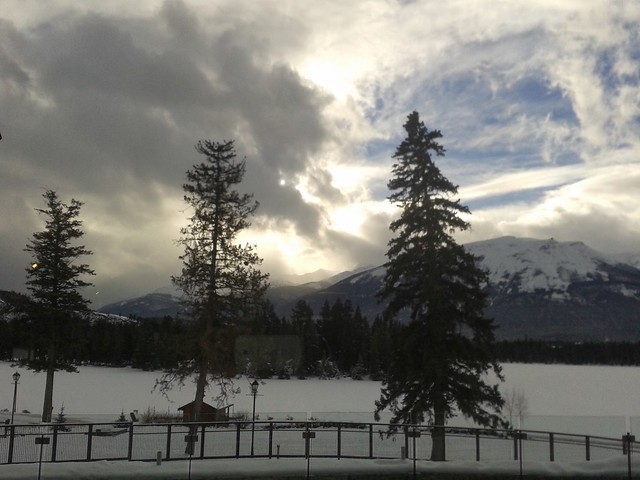
We splurged on a winter deal at Jasper Park Lodge – admittedly a cushy way to experience the wilds of the mountains. From the Great Hall, crackle of fireplace nearby, comforting beverage in hand, bum firmly planted in cushioned armchair, this is the view that greets you:

View from Great Hall, Jasper Park Lodge

And then there’s the view from the trail. Worth getting up for!

How amazing that there is a culturally approved opportunity to bring a real live whole tree into my home to sit in the front window of the living room for all the passers-by to see! It’s such an odd tradition, seen with fresh eyes. Why do we do it? There’s never a holiday where we bring a boulder into our homes.

Whatever the original reason, I’m delighted we do. I love trees. They’ve grown to have a significant place in my pantheon of spiritual practice. It began on a walk I used to take regularly on a path that led beside a row of evergreen trees. They called to me to brush their branch tips with my bare fingers. In winter I’d take off a mitt to let the direct contact happen. I was surprised to notice that I felt a subtle… something. Their energy, is one way of putting it. The trees of a park a little further down the path would call me to place my palm directly on their trunks, standing quietly with the tree. This palm-to-trunk contact inexplicably produces a calming, grounded effect in me.

The weekend has arrived when we must say farewell to the tree that has shared our home for weeks. I sit in the armchair beside it, artificial lights turned off in the dim morning light, so that the tree’s own spirit can shine through. I have treated it as a presence unto itself this year – welcoming it to my home and greeting it with a “hello, tree” occasionally.

Yule tree branch trio

I feel somewhat at odds with the tradition, though – much as I love having the tree in my home, it is a selfish human act. Of course it is dying – has been ever since it was cut – and soon it will be a mound under the snow in the alley.

But even well after cutting, I’ve found that wood retains its spirit. Furniture, walls, stairways, or flooring of wood can have the same effect. A certain cut across the grain to produce a thick sloping table edge fits the human hand well for that buzz of palm-contact. There’s something mysteriously special about trees – when we scurrying bipeds slow our pace enough to soak up their presence.

Dark of Winter

The wheel of the year turns, bringing us round to the dark time. It is the season of long, deep nights, with restful darkness drawn about us like a soft quilt: that comfort at the  heart of winter.

Luminaria in the snowThe ethereal blessing of prairie winter nighttime is the abundance of bright, reflective snow. Every light picked up a million-fold in the water crystals along the surface of their banks and fields. It mysteriously hangs twinkling in the air as if snow fairies had just danced by. It is a beautiful, magical season.

And now, on solstice morning, we’re “half-way through the dark,” as they so aptly put it in a Christmas Dr. Who episode not so long ago. The dark and light ebb and flow, like the ocean tides in celestial slow motion. The darkness now begins receding – and as I sit by my window on this sacred morning, I feel a friendly loneliness for it at the prospect.

Winter Rainbow

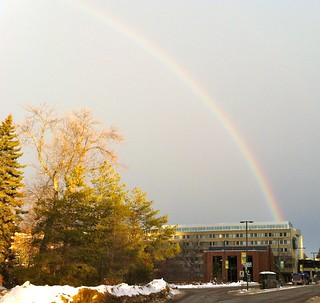
The university at the end of the rainbow

Winter Rainbow!

Very unusual for this northern prairie spot to have rainbows in the winter – this one from last Saturday (Nov 30) is the latest occurring one we’ve noticed here.

A cold snap hit this week, with flesh searing temperatures reaching sub -30 degrees Celsius with the wind chill. Bundling up for commuter walks becomes an art – or an obsession. Dog walks become brief back yard visits, bare canine foot pads carefully protected by small felt dog boots. Nature manifests as the Adversary. Beware the traveller who wanders from the known path!

Accompanying a dog on a nocturnal backyard visit, I am distracted from the seeping cold by the stars’ silent vigil overhead. The calmness of the winter scene settles around me. A muffled crack! fills the air, and another. The sentinel row of spruce standing by a neighbour’s house is popping in the cold, instantly transporting me to the novel I am reading, featuring vivid descriptions of a storm of mythic proportions – a storm for a mythical land.

Stephen King’s recent gunslinger book, The Wind Through the Keyhole, includes storytelling of fantastical weather more extreme than what I am experiencing – a comforting perspective:

 The starkblast comes suddenly, you ken. One moment you’re warm as toast—because the weather always warms up before—and then it falls on you, like wolves on a ruttle of lambs. The only warning is the sound the trees make as the cold of the starkblast rolls over them. A kind of thudding sound, like grenados covered with dirt. The sound living wood makes when it contracts all at once, I suppose. …”

“The temperature can fall to as much as forty limbits below freezing in less than an hour,” Roland said grimly. “Ponds freeze in an instant, with a sound like bullets breaking windowpanes. Birds turn to ice-statues in the sky and fall like rocks. Grass turns to glass.” …

[T]he extreme peril of his situation announced itself in a series of low, thudding explosions. “What’s that?”

“Trees on the far side of the Great Canyon,” Daria said. “Extreme rapid temperature change is causing them to implode. Seek shelter, Tim.”

The starkblast—what else?

A Tale in the Snow

This timeless reflection has such a mesmerizing dreamlike quality…

To one who lives in the snow and watches it day by day, it is a book to read. The pages turn as the wind blows; the characters shift and the images formed by their combinations change in meaning, but the language remains the same. It is a shadow language, spoken by things that have gone by and will come again. The same text has been written there for thousands of years, though I was not here, and will not be here in winters to come, to read it. These seemingly random ways, these paths, these beds, these footprints, these hard, round pellets in the snow: they all have meaning. Dark things may be written there, news of other lives, their sorties and excursions, their terrors and deaths.

From the irresistibly titled book: The Stars, The Snow, The Fire
By John Haines. Published by the also irresistibly named Graywolf Press

Don’t these words leap to mind!? ……… “Winter is coming”…

A book I was delighted to discover lying about the house after my partner returned from foraging in the library, hunting down a quote from our old favourite nature fix – The Road Home.